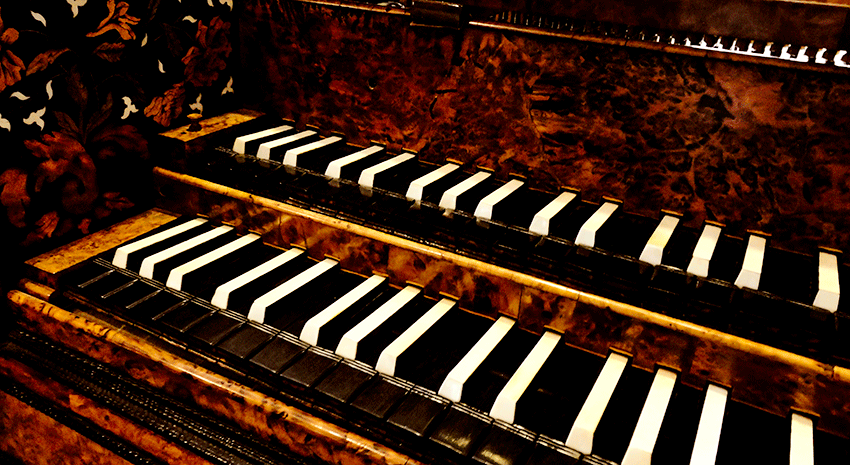
We are in mid-nineteenth-century Paris, the beating heart of Romanticism. Music no longer dwells only in aristocratic salons; it is moving outward, into the great public concert halls. It is an age of gigantism: orchestras are growing in size, and theatres are becoming temples built for hundreds of listeners. The pianos of the time — refined, but fragile — begin to suffer under the new demands. Virtuosi such as Liszt call for more power, and Camille Pleyel, the man who had given voice to Chopin’s very soul — it was in the Salle Pleyel, after all, that Chopin gave his last public concert, on the 16th of February 1848, only a year and a half before his death — searches for an instrument worthy of his hall. The small grand pianos of the day, conceived for intimate spaces, are no longer equal to the task.
It is Pleyel himself who conceives of a giant piano, an instrument whose sound might fill the vast new halls. He works on this radical project for a long time, and in the greatest secrecy, choosing as its stage the Paris Exposition Universelle of 1855 — France’s grand answer to the Great Exhibition held in London four years earlier, destined to draw more than five million visitors from across the world. It was, in Camille’s mind, the only stage worthy of such an announcement: the moment to show that France was still the queen of innovation.
But fate intervened. Camille Pleyel died on the 4th of May 1855, only days before the Exposition opened on the 15th of May. The presentation came to a sudden halt. The project passed into the hands of his associate, Auguste Wolff — under whose direction the firm would soon be renamed Pleyel, Wolff & Cie — who chose not to bring it to the Exposition, even though the prototypes were very nearly complete.
In the middle of a ruthless commercial war among piano brands, it is said that Wolff moved through the halls of the Exposition allowing rumours to circulate: there was a secret project, soon to revolutionise the history of the piano. Yet he never, in that context, revealed its details. It remained concealed.
A few weeks later, however, the first concert grand pianos in history appeared on the stage of the Salle Pleyel and on the market. No one in the world had ever seen — or heard — anything like them, whether in size or in sound. Very few left the Pleyel workshop, and those that did were the most expensive production pianos the firm had ever sold. Each cost 3,200 francs.
From the Pleyel registers it is not entirely clear whether a handful of earlier prototypes had been sold at a lower price. The eight instruments that follow, however, certainly represent the first official production run of concert grands sold at that price:
| Serial No. | Year | Price | Destination / Notes |
|---|---|---|---|
| #22544 | 1855 | 3,200 Fr | Sold to Salvador de Castro — shipped to Seville |
| #22783 | 1855 | 3,200 Fr | Retained by Maison Pleyel |
| #22784 | 1855 | 3,200 Fr | Shipped to Odessa |
| #22789 | 1855 | 3,200 Fr | — |
| #23825 | 1856 | 3,200 Fr | Retained by Maison Pleyel; sold in 1857 to E. Cornu — shipped to Buenos Aires |
| #23826 | 1856 | 3,200 Fr | Shipped to Havana |
| #23827 | 1856 | 3,200 Fr | Retained by Maison Pleyel; sold in 1857 |
| #23828 | 1856 | 3,200 Fr | Shipped to Odessa |
These eight concert grands — the Pleyel Grand Patron Concert Grand Pianos — were the template from which every concert grand we know today is descended. They were dreamed, conceived, and begun by Camille Pleyel before his death. Their historical value is incalculable.
It has always been said that they all vanished in the course of the two World Wars, but, in truth, who can say with certainty? Did the instruments sent to Odessa board a ship for the Far East? Very probably. And the one shipped to Havana? If anyone has news — if one of these pianos has somehow survived — I ask to be contacted personally, out of purely historical and organological interest. It would be an extraordinary rediscovery.
For a long time, the oldest surviving example appeared to be from considerably later batches: the Pleyel Grand Patron Concert Grand Piano of 1860, which belonged to Napoleon III, and which I have had the privilege of seeing on several occasions, on display at the Cité de la Musique in Paris.
Then, without any public fanfare — because at that moment no one understood its true value — around 2010–2012, one of the eight original instruments reappeared. It was #23825, built in 1856, kept within the walls of Maison Pleyel until 1857, then sold for 3,200 Fr to E. Cornu and shipped to Buenos Aires. It is, to this day, the only known surviving example. Its story is a remarkable one.
In Buenos Aires, the Teatro Colón had just opened — the original Teatro Colón was inaugurated on the 27th of April 1857 — an ambitious project meant to bring European excellence to the Americas. To this end they engaged Monsieur Eugène Cornu (1827–1899), artistic director of the prestigious Compagnie des Marbres et Onyx d’Algérie — a celebrated French sculptor, designer, and decorator. Though he worked chiefly in Paris, his name appears often in international art catalogues and in historical records tied to the trade in luxury goods — bronzes, marbles, onyx, and musical instruments of the highest prestige — between France and Argentina. He managed to persuade Maison Pleyel to part with the jewel they had intended to keep for themselves — most likely destined for the Salle Pleyel itself. And so #23825 crossed the Atlantic and shone on the stage of the most sumptuous theatre in South America.
But its glory was short-lived. A fire broke out inside the theatre. The piano did not burn, but a falling chandelier damaged its lid. Wounded, and deemed too complex to repair, the instrument was stored “on its side” — leaning on its flank in a warehouse. There it remained for decades: a sleeping giant protected by dust and oblivion, while outside the world changed and the sound of the piano began its long transformation. As the nineteenth century gave way to the twentieth, cast-iron frames grew heavier, string tensions climbed ever higher, and hard steel wire replaced the softer alloys of the Romantic age; the sound of the instrument itself grew brighter, more metallic, more percussive — a voice designed for the modern concert hall, but no longer the voice that Chopin, Liszt, or Pleyel had known.
The instrument was eventually brought to Italy by an Italian-Argentine family and, around 2010, sold to an antiques dealer who entrusted its restoration to the luthier Ugo Casiglia, in Sicily. Even then, its historical significance was not yet fully understood. It was only later, when it was acquired by a private collector, that its value was truly recognised and honoured.
Some time afterwards, the legendary Parisian technician Desfougères, who had guarded for decades — as though it were a treasure — a piece of precious felt made with techniques now lost, and who had kept it aside “for the right moment,” learned of the rediscovery of #23825. He understood at once: that felt, preserved for a lifetime, was the perfect dress for the hammers of Pleyel’s giant. It was the final piece: period material meeting period structure.
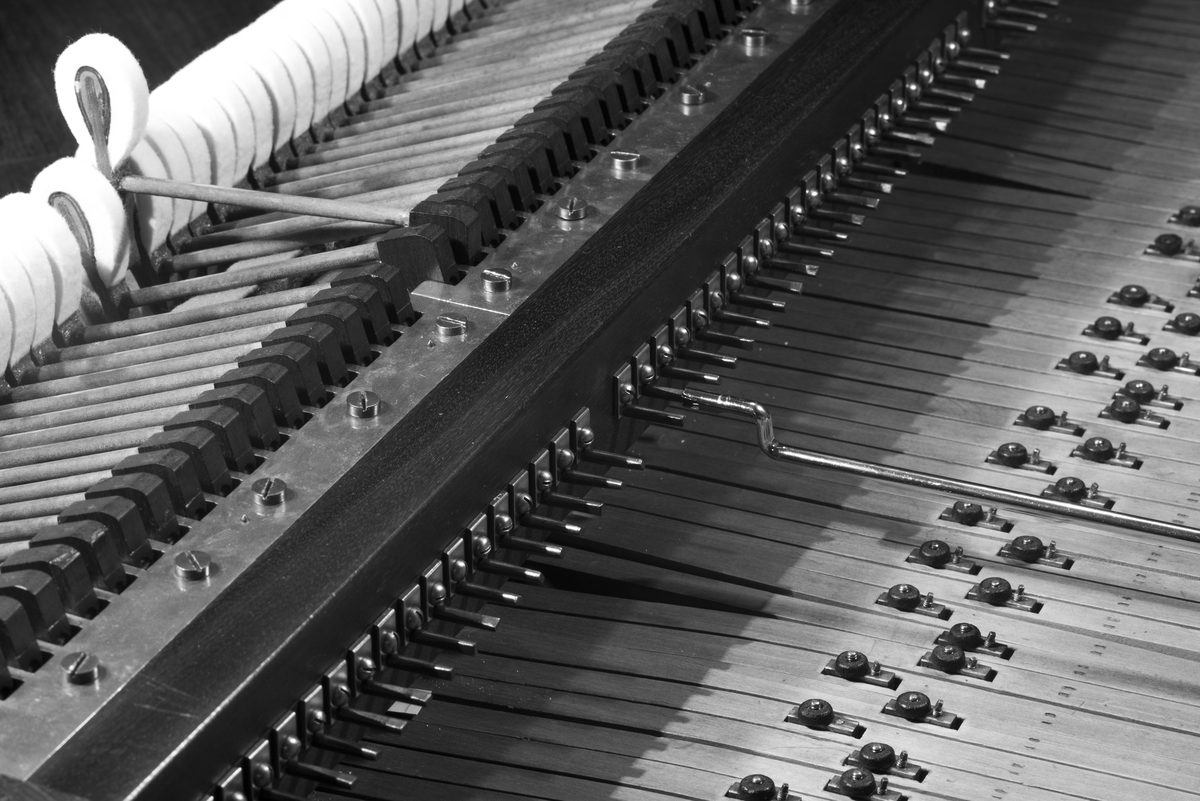
During those same years — while I happened to be preparing my thesis “Technical Chronology of the Piano” for the Advanced Course in Piano Tuning and Technology at the Santa Cecilia Conservatory of Music in Rome (2015–2017) — I personally came across this very instrument and I had the real opportunity to measure, with my own hands, one of these original Pleyel Grand Patron Concert Grand Pianos.
What Wolff and Pleyel had created was, technically, a monster of beauty. It bears the 1855 Gold Medal on its fly lid. It is 285 centimetres long. To appreciate the audacity of that measurement, one must consider that the legendary Fazioli F308 — today the longest production piano in the world — has a speaking (suspended) string length of 224 cm. The Pleyel, built 170 years ago, boasted a speaking string length of 212.2 cm — a mere 11.8 cm less.
Today, the Pleyel #23825 is not merely a relic. It is a presence. Of course, the original action is fragile. The tuning does not hold for long. And yet, the moment fingers touch the keys, it is not only sound that rises: it is a halo. An acoustic aura that envelops the listener, a reverberation that seems to come from another dimension. Played with the gentle melodies of Debussy or Chopin, the instrument ceases to be wood and wire; it becomes breath. Its volume is imposing, but it never assaults — it caresses. It is so powerful in its sweetness that modern pianos placed beside it are drawn in, as if swallowed by its emotional gravity.
Today, 170 years after its making, to save the memory of this instrument is to save a way of understanding music itself: not as a performance of force, but as a vibration of the soul — one whose mere proximity is enough to change the listener forever.
Margaret Penn 2026